Ethos is not a mental health app. But it can help you significantly by improving your habits and encouraging revisions to your principles, if the gap between these two things is a factor for your mental health.
Ethos
A private system for managing the principles you live by — and the experiences that shape them.
...or scroll down to learn more about this unique app.
What is Ethos?
Ethos is designed for people that realise life never stops educating us, and we should constantly adapt based on what we learn. It is to help us define who we are now, analyse the gap between that and who we want to be, and update our vision of who we want to be, if necessary. It is grounded in your habits, and how your habits reflect your principles, and whether our principles need to change.
What Ethos is not
Ethos is not a journalling app, however journalling is one of its features. If you wish to use the journalling feature, then it can help to prompt your thoughts about what is working for you and what isn't.
Ethos is not a social platform. There are no likes, subscribes, or comments on anything you input or create. Ethos does allow you to share a journal entry, or even an entire Ethos, if you wish. But there is no obligation at all, and the feature is only there in case you wish to share an insight on your preferred social platform.
Ethos is not an AI-first platform. Everything that you do is written by you, reviewed by you, revised by you. There is the option of adding AI assistance, but this is purposefully not as easy as clicking a simple button. Ethos does not want to see your data and what you are sharing with an AI agent. For this reason, if you do wish AI assistance, you must follow the instructions to acquire your own API key. From that point onwards, all conversations between you and the AI are between you and the AI, and not with the creators of the Ethos app.
The idea behind Ethos
Ethos is a private, encrypted journalling app built around a simple but powerful idea: that who you are is not fixed, and that the gap between the person you intend to be and the person you actually are is worth studying honestly.
∞
It is more than just a journal — entries are more than diary entries. Each one is linked to your ethos: a living record of the principles you want to live by. When life teaches you that an old belief was too simple, you refine it, note why it changed, and link the revision back to the experience that prompted it.
∞
A habit tracker lets you see whether your daily actions reflect your stated principles. And once a week, a reflection prompt — generated from your own data — asks you to look at the pattern: what held, what didn't, and what needs to change.
∞
All of it is encrypted and stored in a file you own. By default nothing leaves your device and no algorithm reads your reflections — that only changes if you turn on AI assistance or choose to share.
∞
Think of it as your own set of commandments. The difference being, they are not written in stone.
It belongs entirely to you.
Open Ethos →Free to use. Local-first and private by default.
A look inside
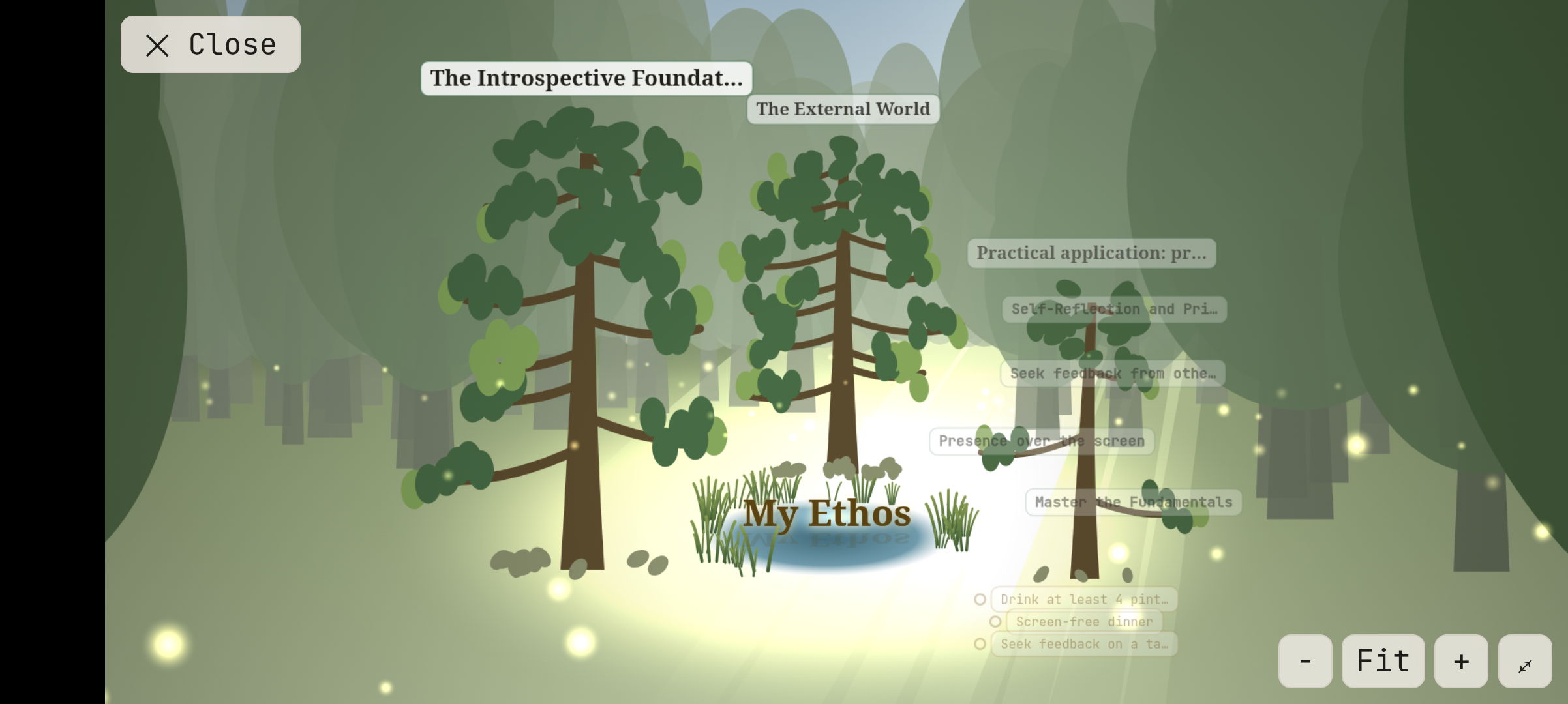
At the heart of Ethos is a forest that responds to how you tend it. Honour your habits and the foliage stays lush; let things drift and leaves brown and fall. It's a calm, wordless reflection of how closely you're living by your ethos.
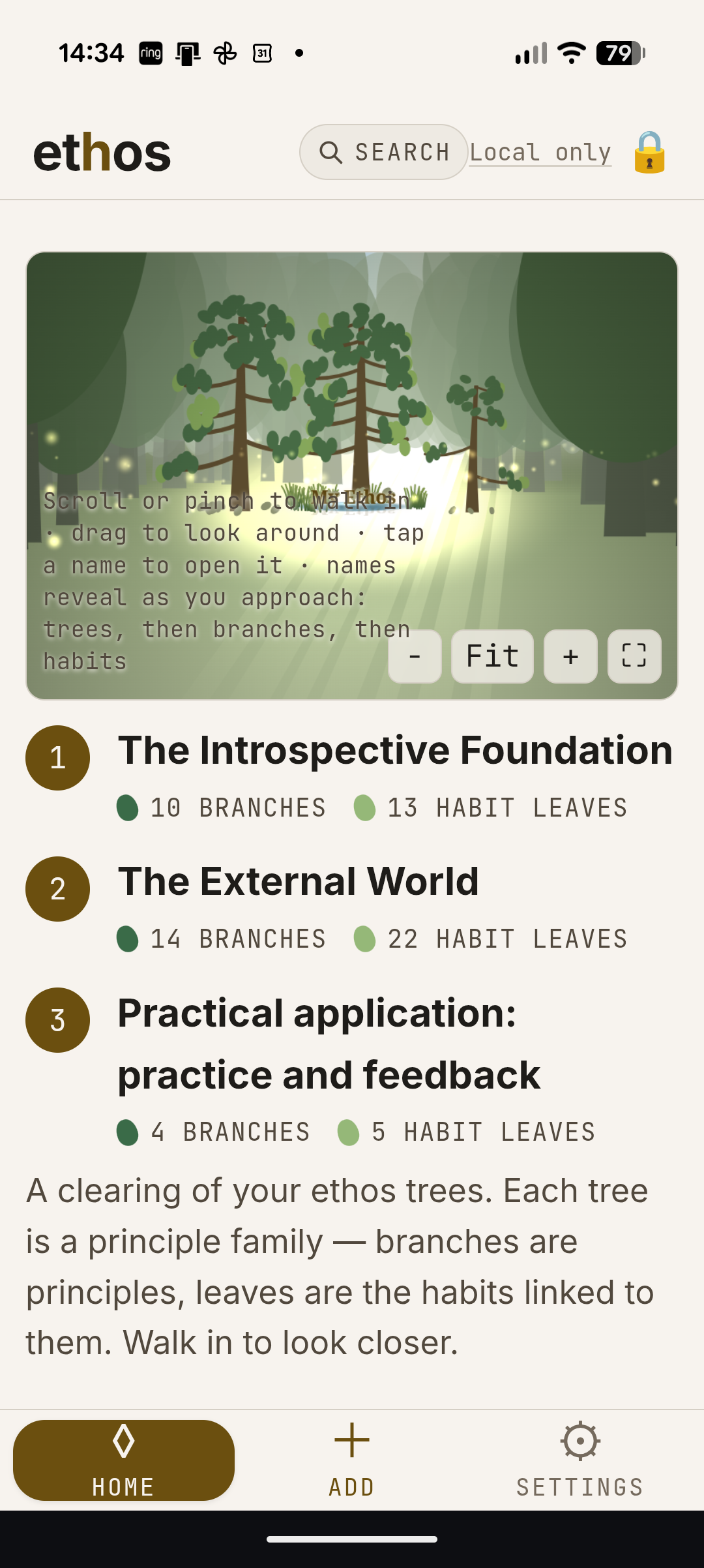
Everything opens to the forest, with your week's measures and the way into each section just beneath it. One glance tells you how things stand before you decide where to put your attention.
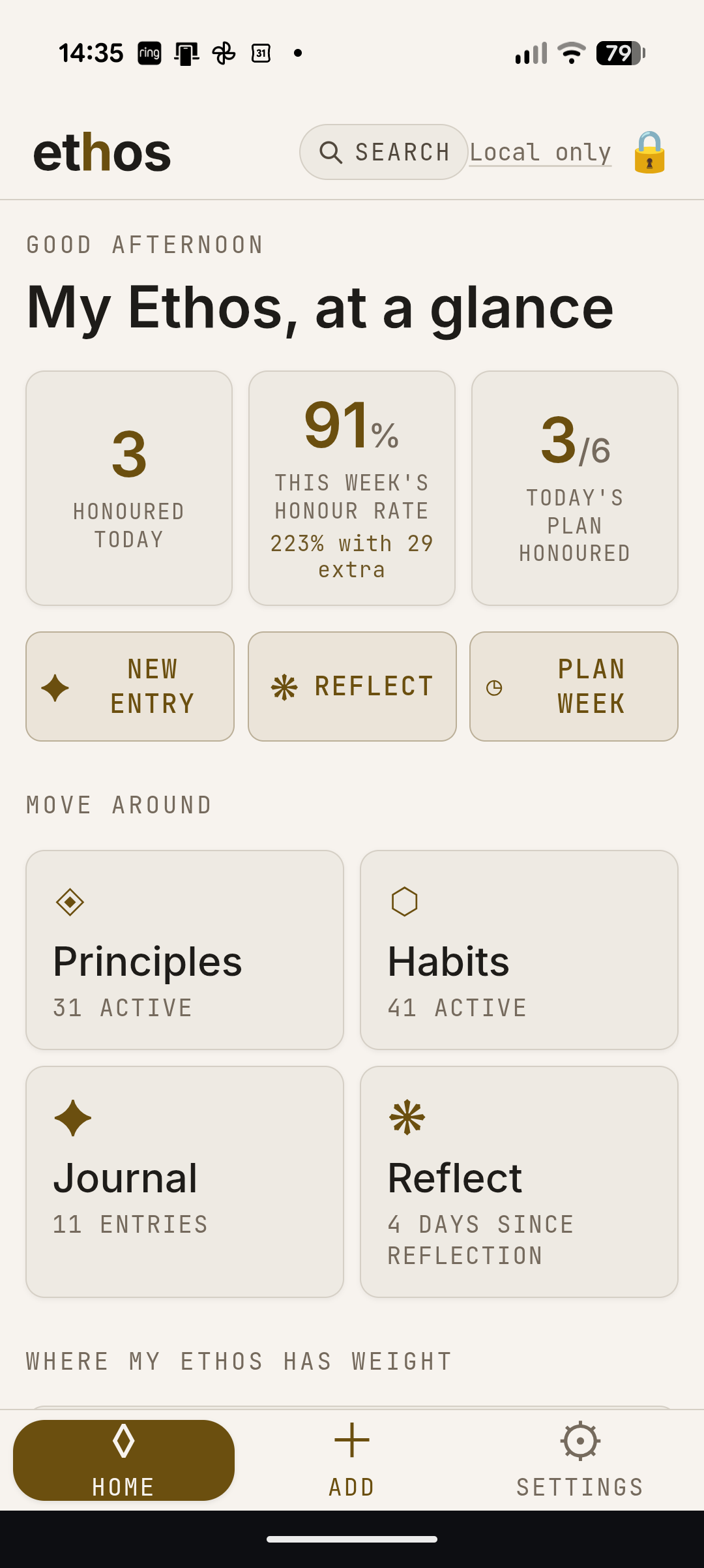
Below the forest sit your at-a-glance measures and the four rooms of Ethos — Principles, Habits, Journal and Reflect. Together they form one loop: decide who you want to be, act on it, record what happened, and learn.
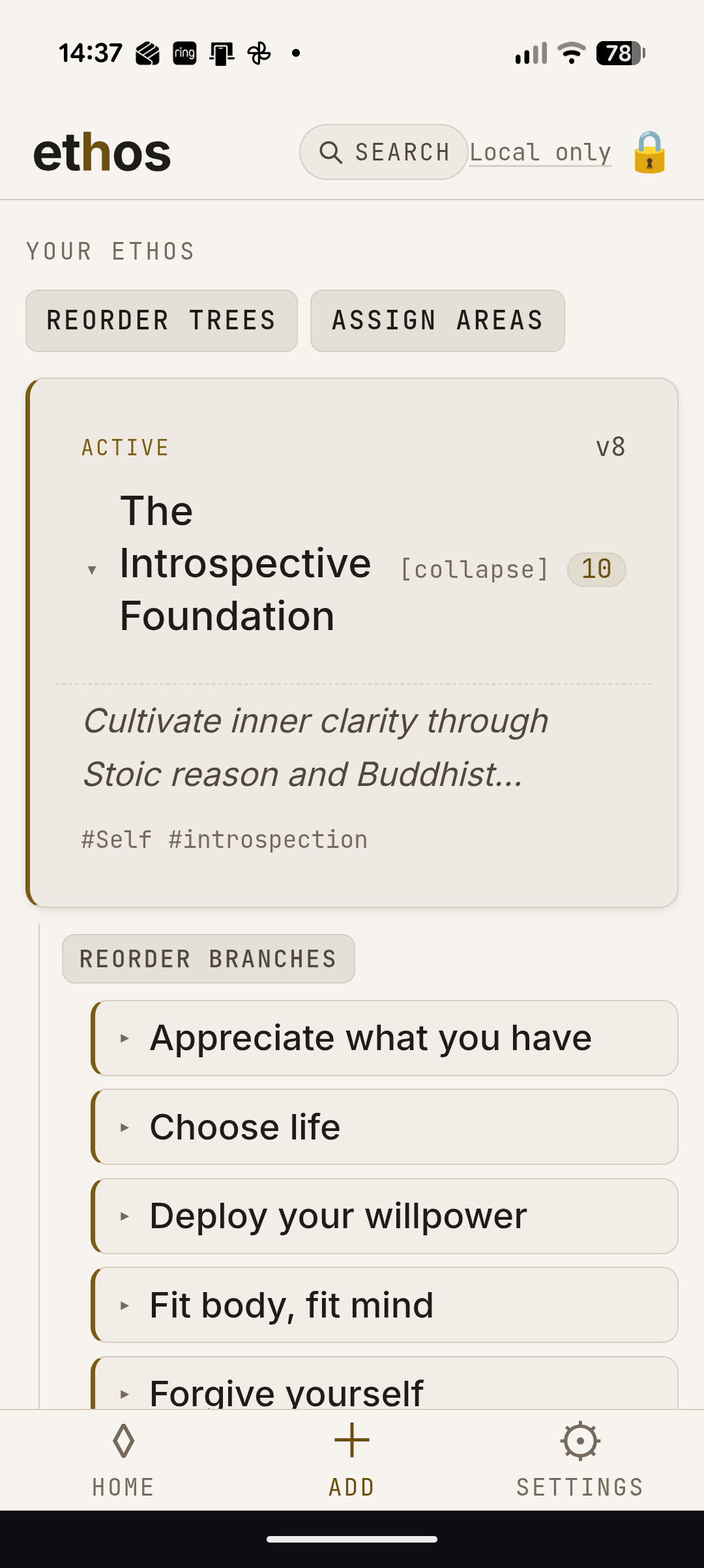
Open any principle to see the belief in full, the pillar it serves, and the habits and entries tied to it. Every edit is kept, so a principle becomes a record of how your thinking has matured.
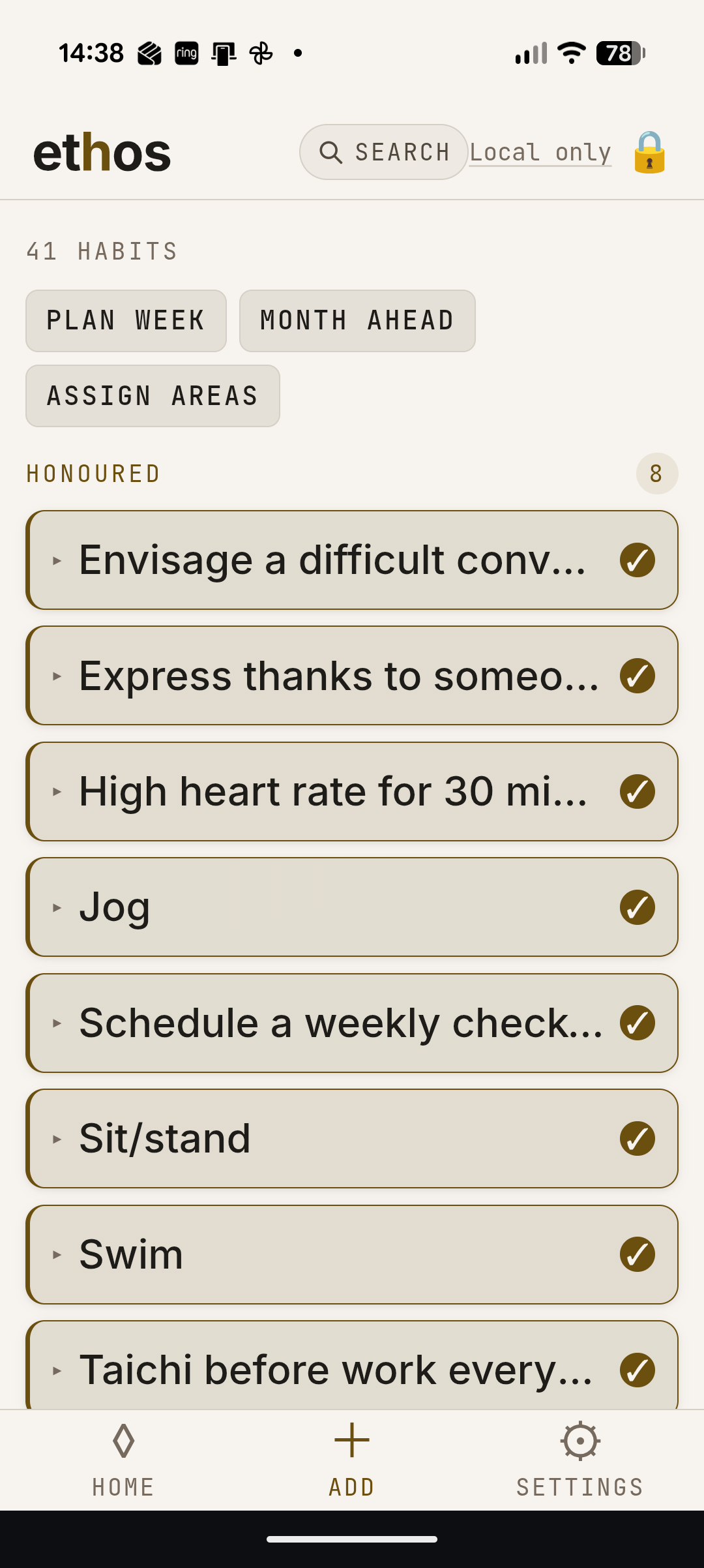
Each habit shows its rhythm, its progress, and the principle it upholds. Honour it with a tap — and if a daily rhythm starts to slip, Ethos gently suggests an easier cadence rather than nagging.
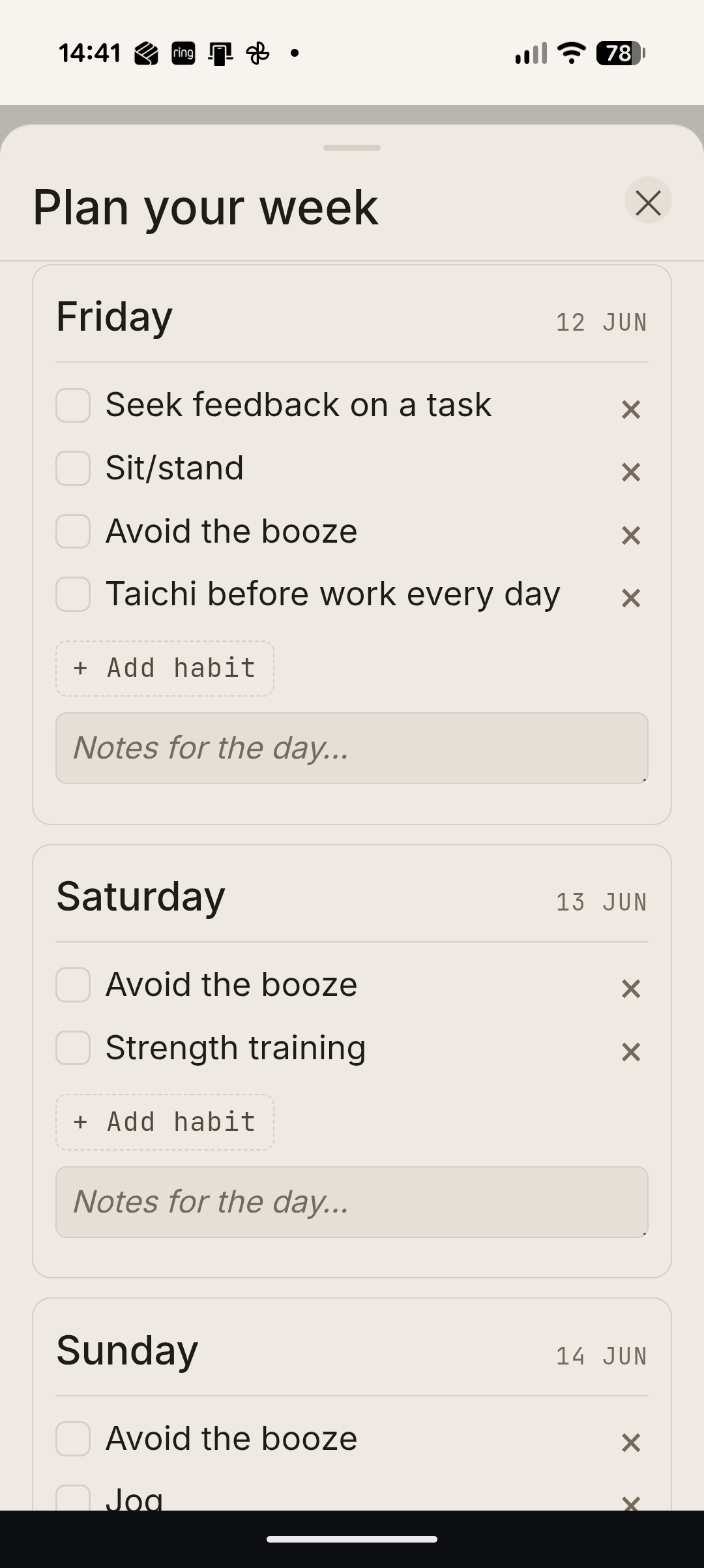
Lay out the week with today at the top and the days behind you tucked away. Drop in scheduled habits and one-off tasks, each tied to a principle or area of life, so your week mirrors what you care about.
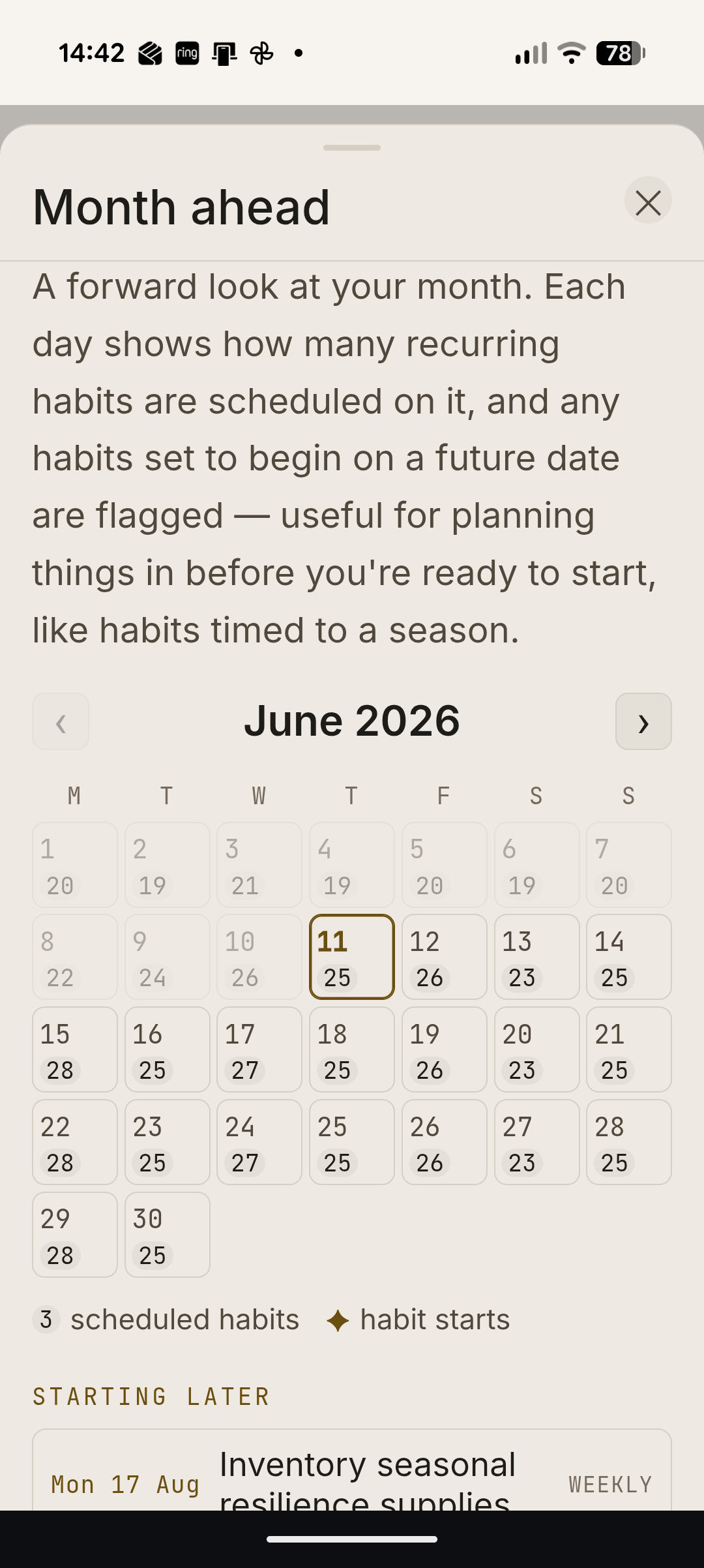
A forward-looking month for the things that aren't for right now — monthly habits, and routines you'd like to begin when the season or the moment is right. Plan a winter habit in autumn and let it wait until its day.
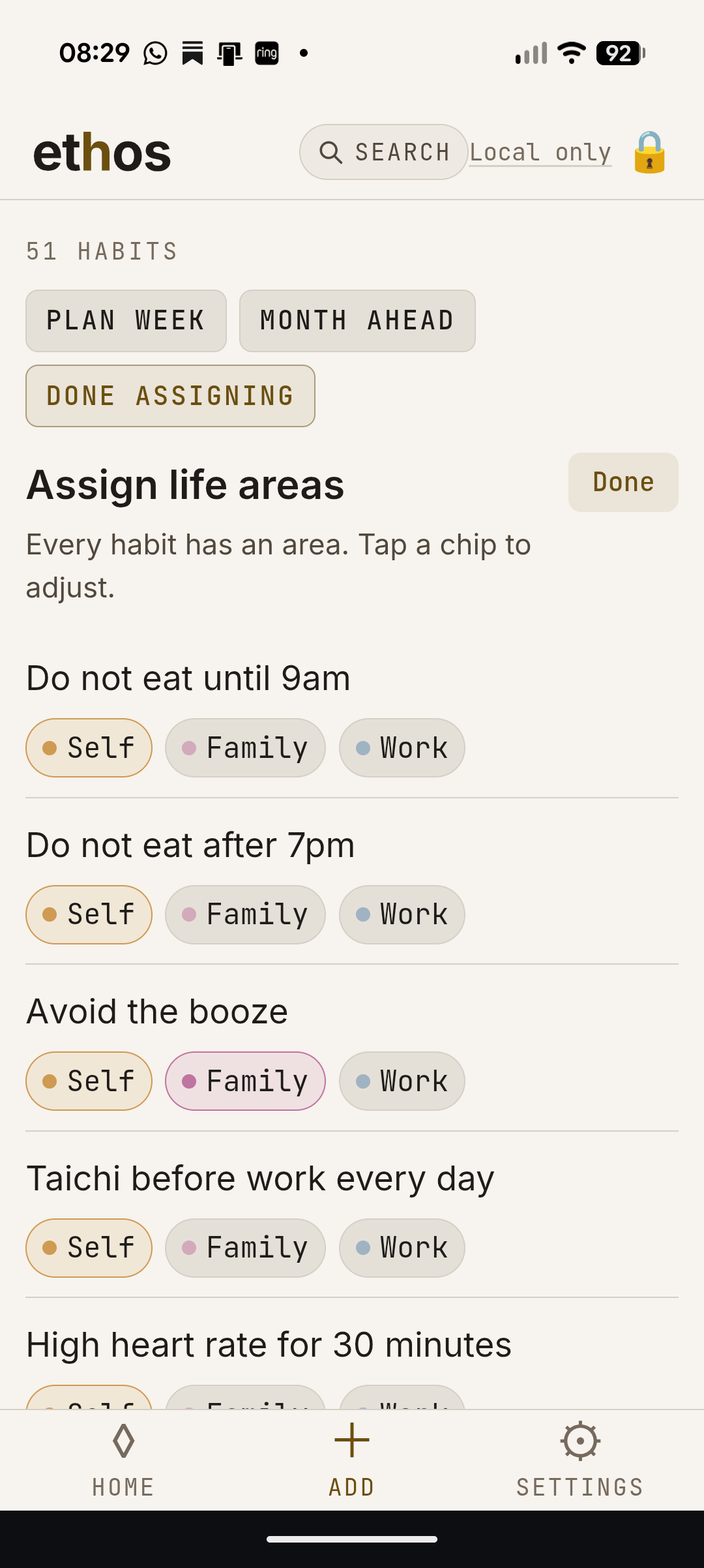
Assign habits and principles to the areas that matter — work, family, self, whatever yours are — and Ethos shows where your effort is really going, so you can adjust before life is pulled too far one way.
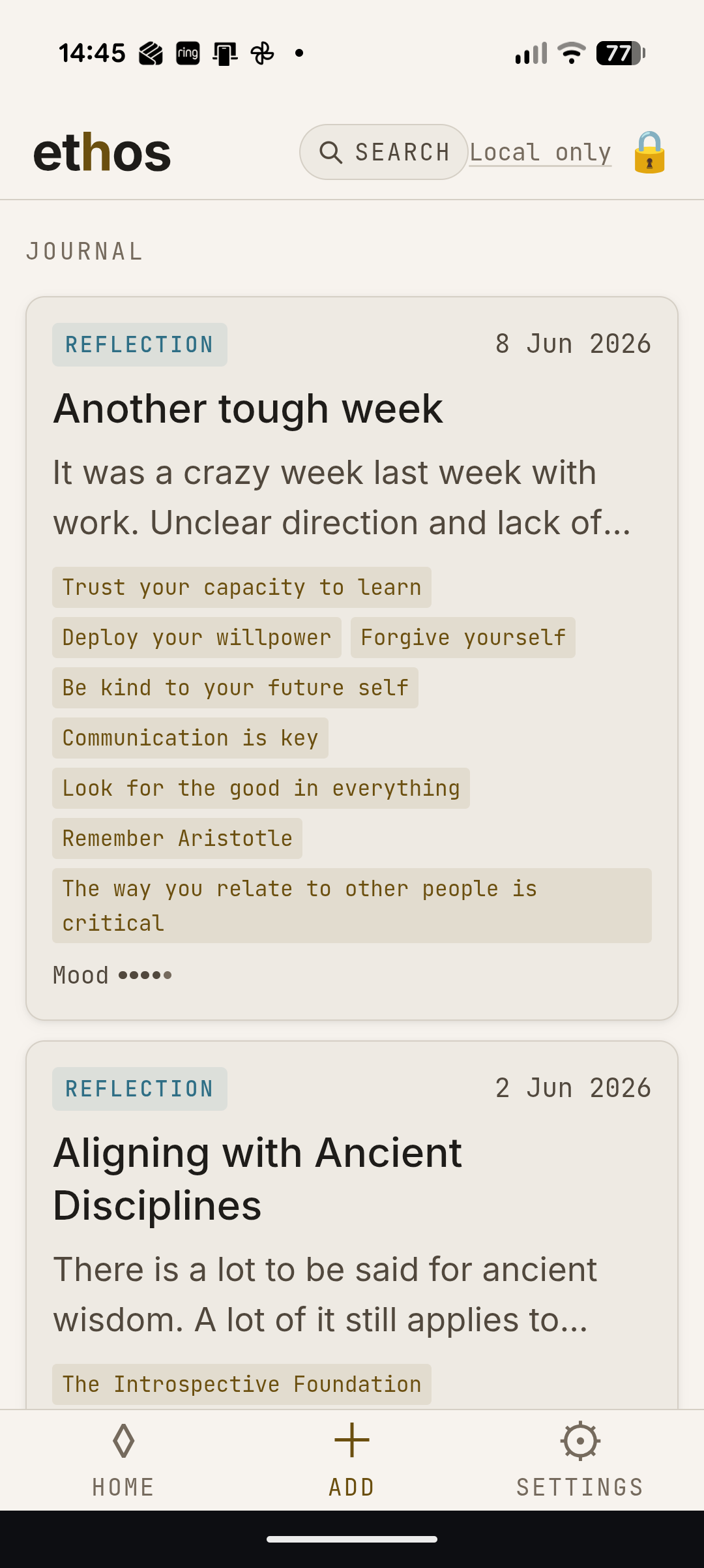
Write what really happened — a decision, a mistake, a small win — and link it to the principles and habits it touched. Each entry is a piece of the evidence behind your ethos, and yours alone.
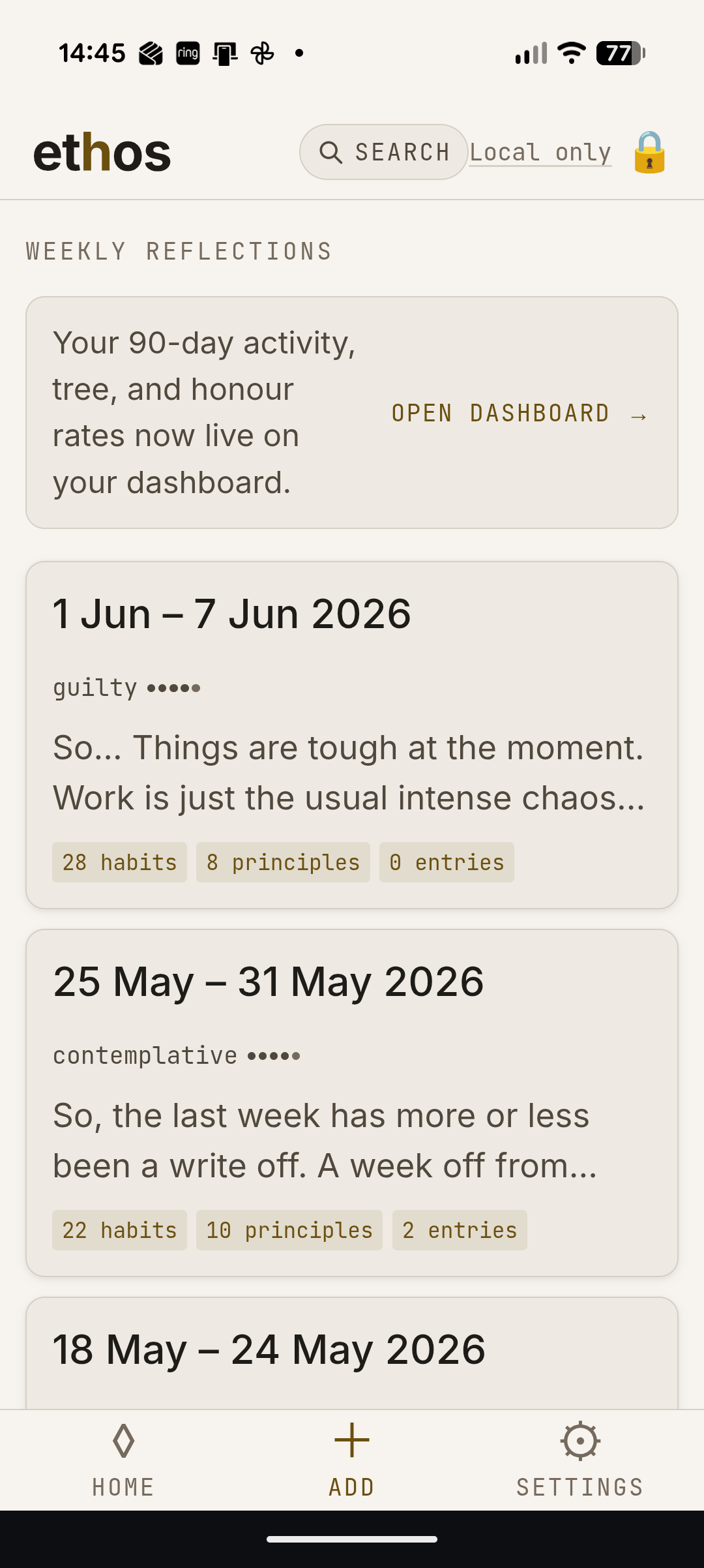
Once a week, a prompt drawn from your own data invites you to step back. Note what's working and what isn't, and let the insight feed straight back into the principles and habits you carry forward.
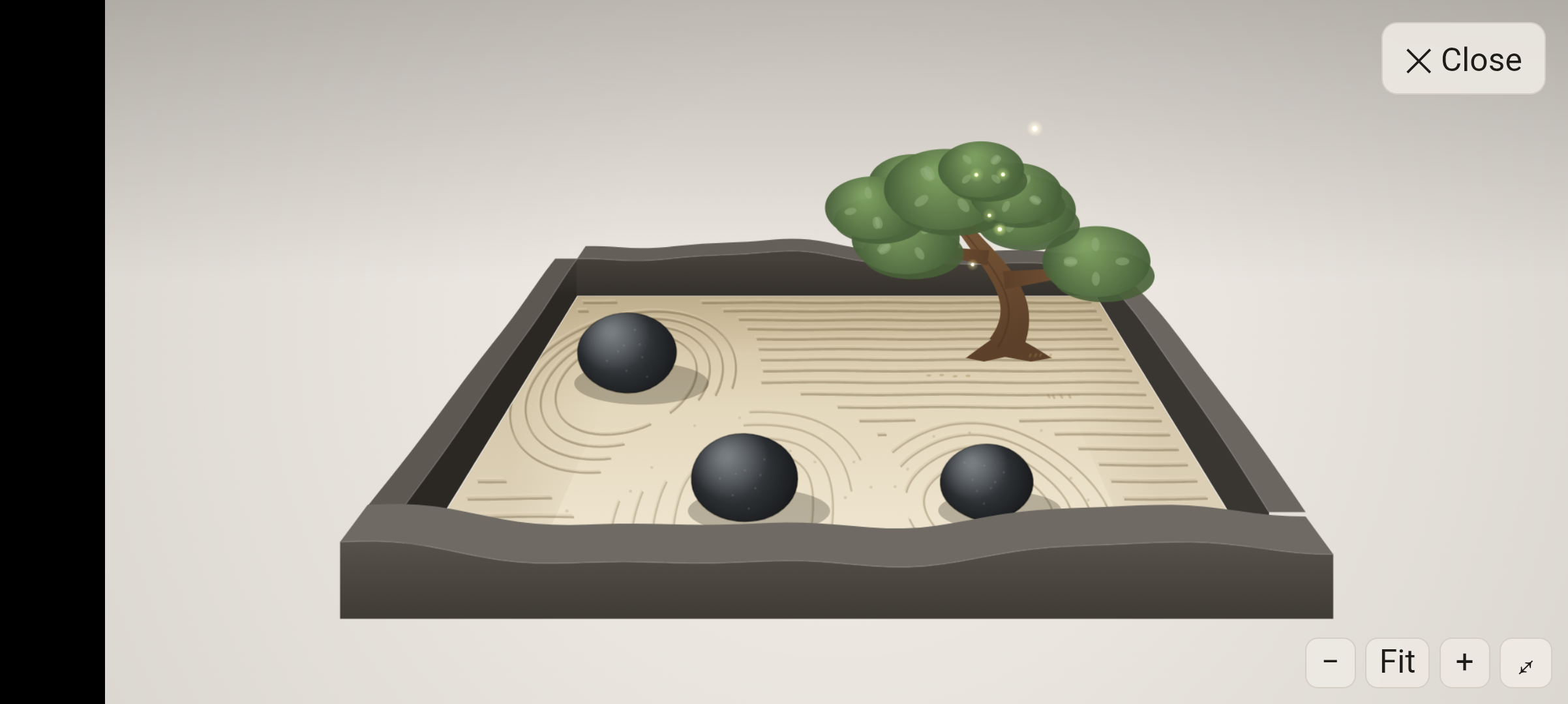
A second, quieter view of balance: a raked-sand garden whose stones and bonsai settle when your areas of life are in proportion, and drift when one is taking more than its share.
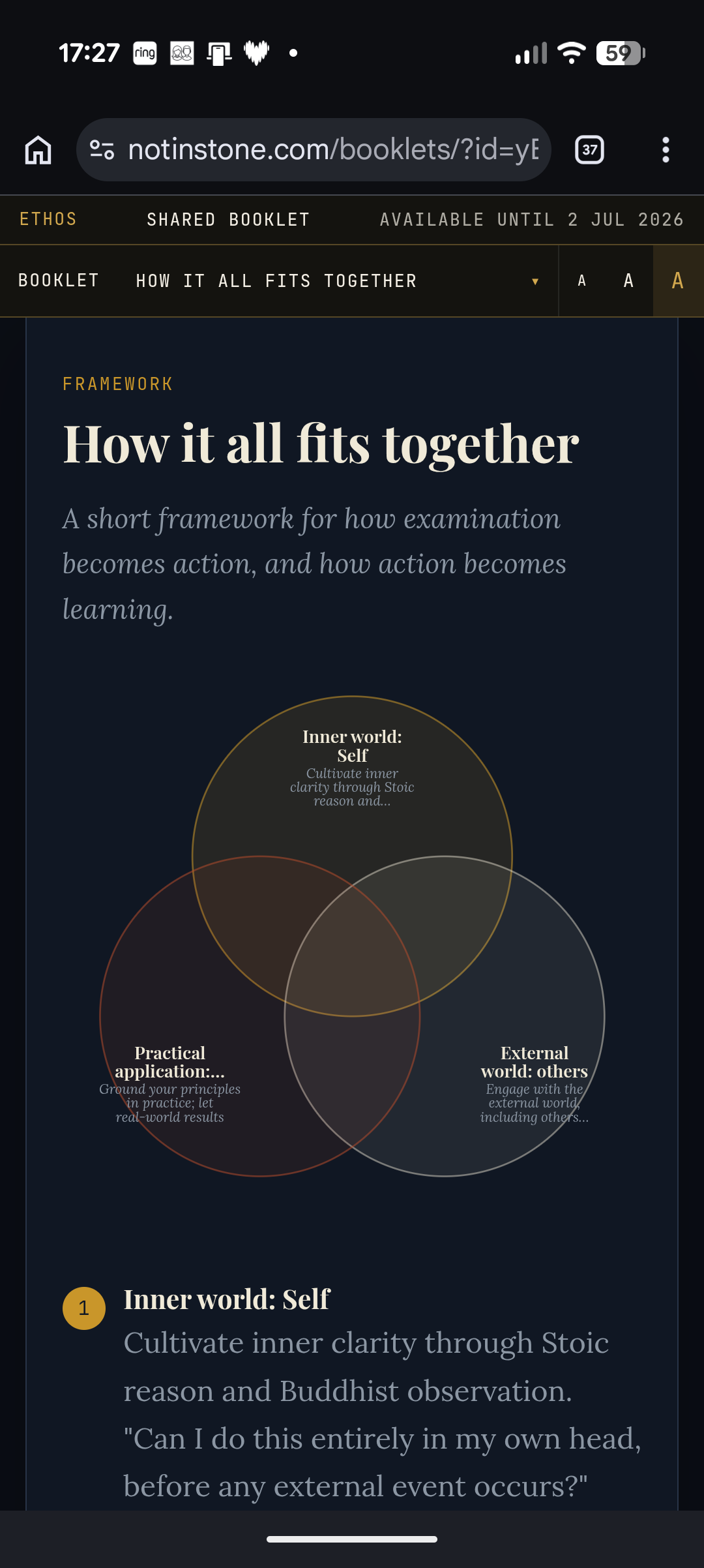
When you're ready, weave it all into a private, beautifully styled booklet — yours to keep, pass on, or share securely with someone who matters.
Privacy Policy
Ethos is local-first. By default your data is encrypted and saved to a file you own; the app is a static site with no database and stores nothing about you on any server.
Your data only leaves your device if you choose one of two optional features:
AI assistance — when enabled, your browser sends only the text needed for each request (a habit, a principle, or a short journal excerpt) directly to the AI provider you choose, using your own API key. Ethos never sees, proxies, logs, or stores your key or that text. The provider handles it under their own privacy policy.
Sharing a journal entry or ethos — when you create a share link, an end-to-end encrypted copy is uploaded to a host so the link works. The decryption key stays in the link you share; neither Ethos nor the host can read the contents, and links expire and can be revoked.